The season of curriculum reflection
Written September 2026
September is always a time of curriculum reflection, but this has perhaps never been more true than now when we are expecting the imminent release of the new draft national curriculum. Some HODs and curriculum leaders are new in post and will be familiarising themselves with what’s in place in their context, some are returning to curriculums where they still feel more work needs to be done and some (either new or returning!) may be wanting to rip everything up and start again…
Whatever your situation, there is plenty to aid us with purposeful curriculum reflection. In particular, I’ve been grateful to Mark Enser and Rob Chambers for their recent highly readable and engaging blogs on their Substack channels. If you don’t regularly engage with the work of these two geographers, now is the time to start.
As I write the KS3 Common Curriculum for Future Academies, I’ve reflected more than ever on what we do and why. Here I argued strongly against starting Year 7 with anything that remotely resembles a unit of ‘geographical skills’ or ‘introducing students to the world’ (think the ‘Fantastic Places’ units of old). I explained why we have started with Population Dynamics and what is covered in this unit underpinned by the big question of ‘How and why do populations change?’. Here I argued for studying development before tectonics and how, in doing so, I think we unlock a key piece of the progression puzzle in our horizontal discipline. And finally, here I’ve explained the thinking behind the texts used in our Year 7 and Year 8 curriculum to ensure that, rather than use text for the sake of it, we’re ensuring genuine progression in what our students are reading throughout their geography journey.
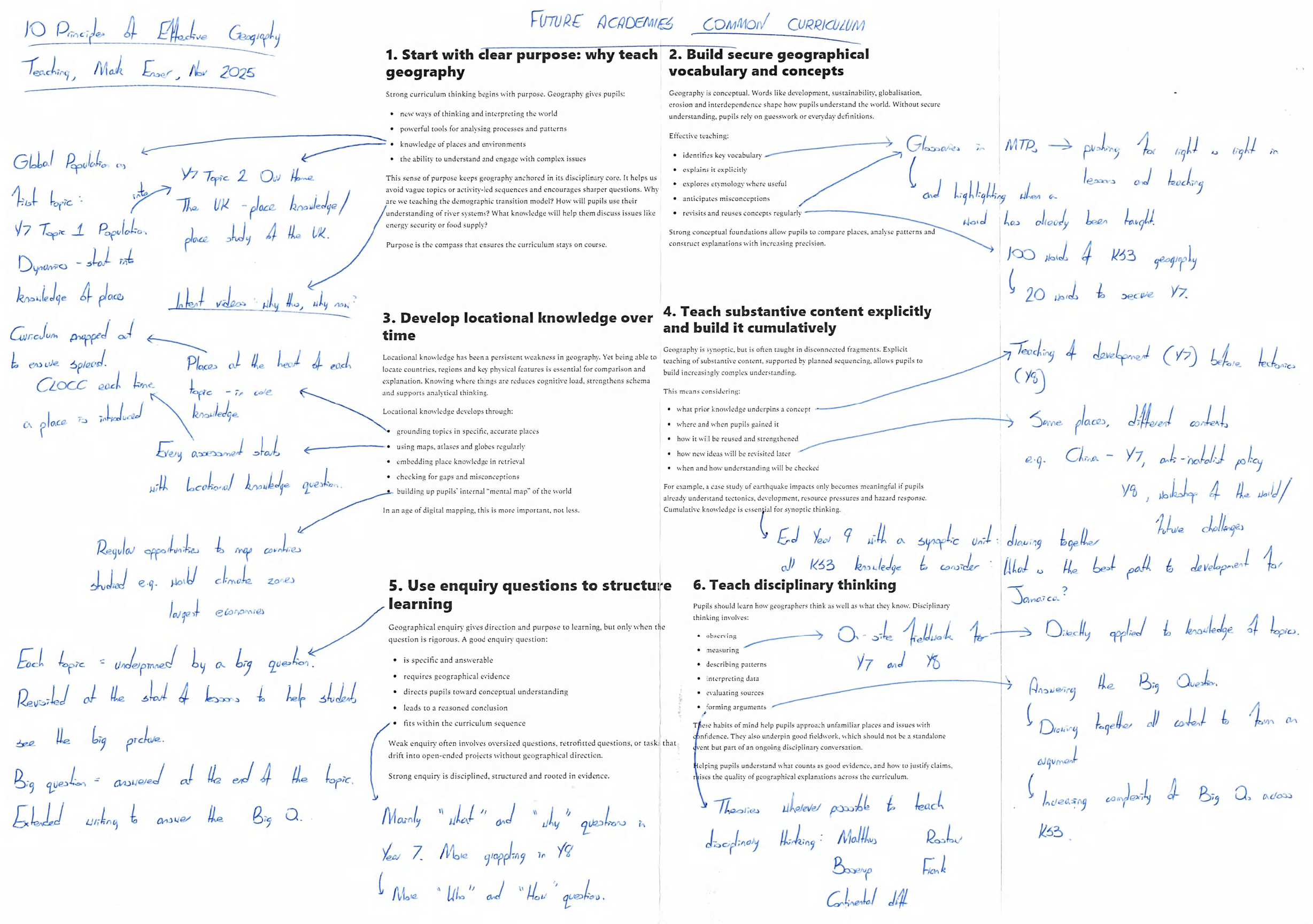
As the academic year of 2025-2026 drew to an end and, having rolled-out the Year 8 course of our curriculum, I found myself wanting to step back and audit my thinking and approach. For this, Mark Enser’s November 2025 blog of the Ten Principles of Effective Geography Teaching was invaluable. As you can see from the image below, I screenshotted Mark’s ten principles and printed them onto A3. I then challenged myself to step-back and think: do we do this? How? Where? Why? And perhaps more importantly, how do I know we do this well?
The result is the image below: an A3 sheet covered in annotations of what I’ve built into our Common Curriculum in my role as Trust Lead. Some of these annotations relate to the ideas blogged about above and other blogs here. Some relate to approaches, ideas or arguments that I hope to share more on this academic year. Some are, excitingly, showing how we might adapt our existing curriculum to meet the requirements of the new National Curriculum- given we already know a fair amount about the direction of travel.
Doing this audit the ‘good old-fashioned way’ with a pen and an A3 sheet of paper really helped me to step back and think and I’d highly recommend you do the same!
The scanned-in PDF of my notes is here.
Mark’s blog can be accessed here.