What if… we ensure progression in reading?
Written May 2026
Updated September 2026
The use of high-quality text in geography lessons and geography curriculums is something that’s changed a lot in my 11 years teaching. For me, it begun many years ago now with seeing the work of Alan Parkinson, Matt Podbury, and others, and how they used Factfulness as a resource in the classroom. This led to me, for a few years, teaching a scheme of work based on this book in Year 8 with another based on The Almighty Dollar in Y7. Both were highly enjoyable to teach and, I’d argue, served as excellent conduits with which to teach ambitious and rigorous geographical knowledge at Key Stage 3.
Beyond the geography community, the work of Mary Myatt and others has encouraged us all to think carefully about how we use text in our subject and if you haven’t already seen The Ambitious Years project of Myatt and Co then I urge you to! I would also highly recommend reading this blog by Rob Chambers about Reading Aloud- it will give you plenty of food for thought about the intent of reading in the curriculum before this blog focuses more on an example of implementation within KS3 geography.
So, we’ve certainly made real and worthwhile progress with regards to ensuring students are reading more (and resources of better quality) in our geography classrooms. The conversation has continued apace and a myriad different ideas have been shared about how to increase the amount of reading in geography classrooms.
However, as I work on the third KS3 curriculum of my career and do so with a ‘blank slate’, I’ve been forced to reflect on reading in geography and my use of text in the curriculum. Put simply, I fear that in recent years I had begun to lose my way with regards to the purpose of text in our curriculum. As I shared here in the context of KS5 teaching, I had become guilty of starting to pepper our curriculum with quotes and book extracts without really thinking about the purpose. Based on posts I see on social media, I fear I am not alone in that.
So, over the past year or so, I’ve stepped back and forced myself to think carefully about how reading can form part of the progression model of our geography curriculum. I am incredibly indebted to George Charles for her guidance here, in her time as my line manager at Future Academies. Which texts are we reading when and why? What is the purpose of each text used in our curriculum, and how it is enhancing and enriching the lessons? How does our use of text progress through Key Stage 3 and beyond?
Having done this careful thinking, the text below is what has been shared with the geography teacher community of Future Academies. Hopefully you find it useful- note that it only goes up to half-way through Y8 as this is where we’re up to with our curriculum roll-out.
How do we develop reading in our KS3 geography curriculum?
Future Academies set out a clear mission that all schools fulfil The Reading Guarantee. This mission aims to ensure all our young people leave our care able to read well and can engage with rich reading materials throughout our ambitious curriculum. For this reason, we have carefully considered what students are reading in geography and the progression of disciplinary reading in geography. We have selected and designed authentic reading materials to build in challenge cumulatively similarly to how we develop core knowledge, vocabulary and geographical skills over time. Students will be exposed to a range of linear and non-linear reading materials in the curriculum. Here, we outline our approach to linear reading materials used to supplement exposition in the discipline.
When reading in the geography classroom, we must be clear on the purpose of the text: why are we including this text and asking students to use lesson time to read it? Is it enriching the curriculum and the core knowledge of this unit? Is the use of text helping us to achieve our lesson, topic, and curriculum end points?
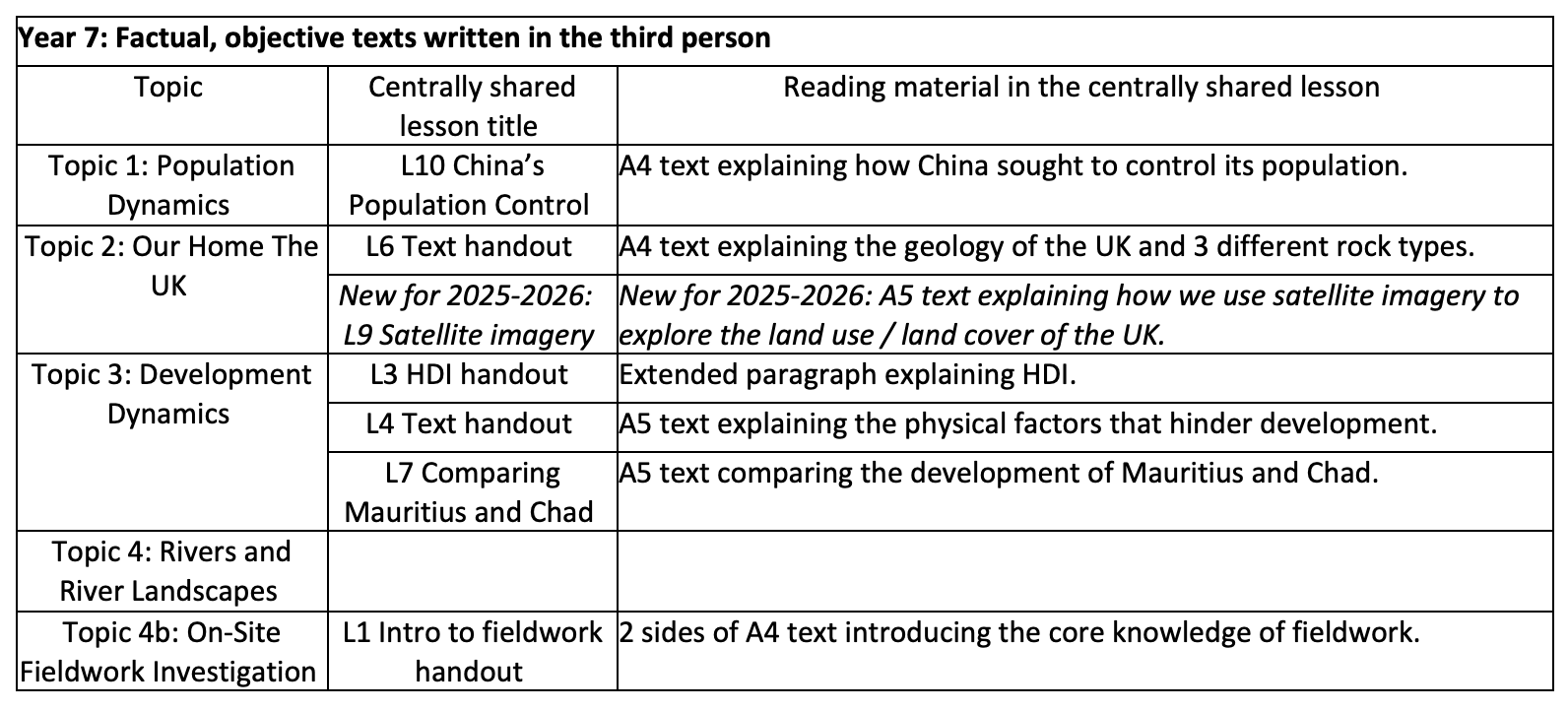
In Year 7 geography, we favour factual, objective, explanatory text (written in the third person) to enrich our curriculum. We use this style of text throughout Year 7 for many different reasons:
1. It is the most common type of text that an expert geographer engages with.
2. Because it is written (or heavily adapted) by us, the curriculum writers, it is directly aligned to the precise core knowledge of our curriculum and accessible to our students.
3. Because it is written (or heavily adapted) by us, reading materials are more complex than what students would read alone however feature vocabulary that is taught in our curriculum and therefore supports vocabulary acquisition.
The table below shows where this style of text is used in the centrally shared resources for the Year 7 topics.
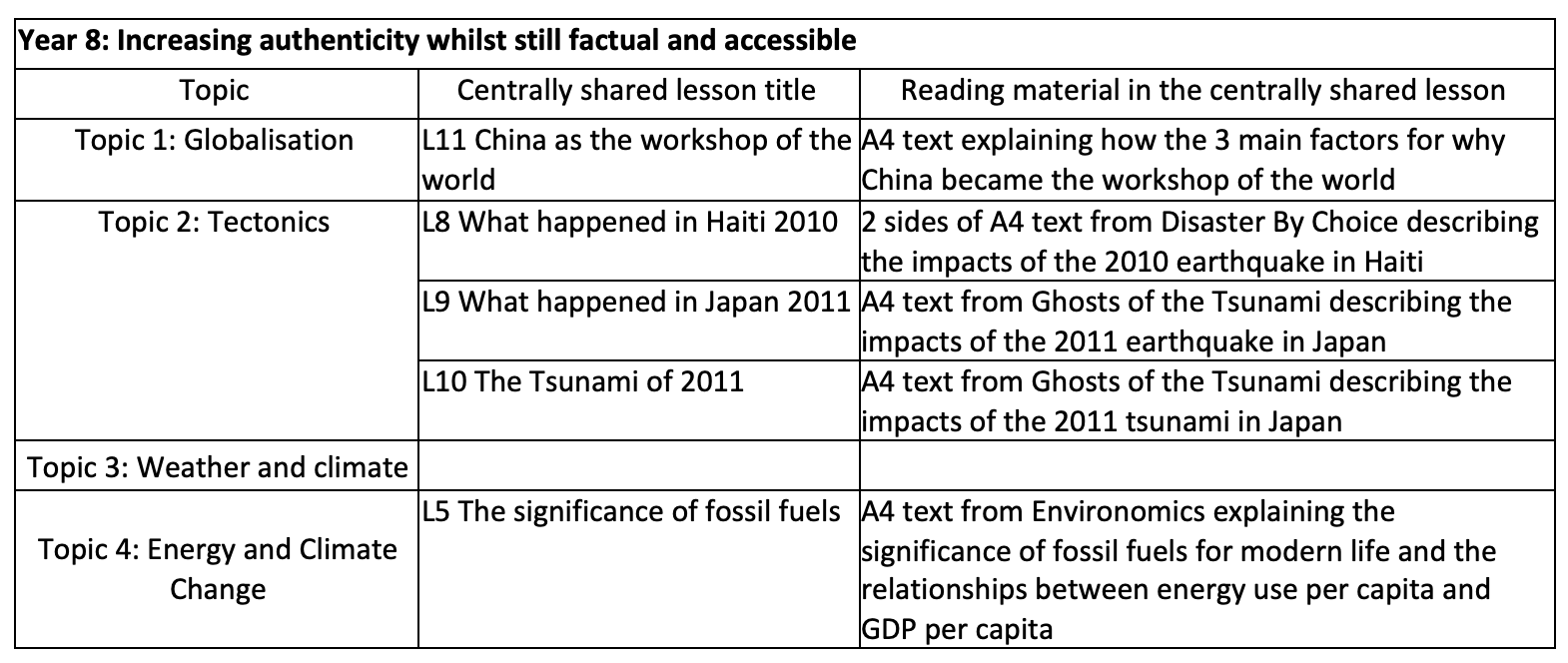
As we progress through our curriculum, the texts that students read and engage with become more challenging. Whilst objective, third-person pieces of text remain, students will also read texts in other formats, from a different perspective, and with more challenging vocabulary. Whereas Year 7 saw students engage with explanatory texts to teach foundational knowledge, Year 8 introduces more authentic geographical texts. This provides a progression model for reading within our geography curriculum.
For example, in Topic 2 of our Year 8 curriculum (Tectonics), students use texts from geographical books for the first time. Extracts from Disaster By Choice and Ghosts of the Tsunami are used. These accessible yet ambitious texts still help us to explain curriculum concepts but do so in a more authentic way. In this topic, these rich descriptive extracts are read and unpacked to help make the abstract idea of experiencing an earthquake and tsunami more concrete for our students. Although still grounded in facts and written in the third person, these texts are richer with many layers to interpret and unpack- making them more challenging than our Year 7 tasks because of the comprehension skills required.
When we use a piece of text in our Future Academies geography curriculum, we adhere to the following principles:
It is always printed and not read from the screen.
In the very best practice, the projector and screen will likely be turned off for the duration of the reading and corresponding tasks (‘pressing ‘B’ whilst presenting in PowerPoint is the easiest way to do this).
As the most expert reader in the room, the reading of the text is led by the teacher.
Where needed, a glossary is provided at the end of the text which defines the key vocabulary found within the text. If a word is not defined in the glossary but warrants clarification, bracketed meaning is used for implicit vocabulary instruction.
Time is taken to break down the text into logical and manageable chunks.
Checks for understanding throughout the text are pre-planned to ensure key concepts and knowledge from the text is understood.
The text is used for, or applied to, a written task after the reading is complete.
As I said above, I hope this reflection offers some food for thought about the text extracts used in your geography curriculum and what it looks like to ensure that there is a genuine progression model of reading in your curriculum, as I’m striving to. As always, all thoughts, feedback and comments welcome!