Discover Geography From Collins
Written April 2026
A while ago, the team at Collins kindly sent me the Year 7 resources of the Key Stage 3 ‘Discover Geography’ package to look at and review. With a formidable group of geographers responsible for writing this series, I was intrigued to deep dive into the resources and consider what I could learn from the approach taken by this team.
Organised around nine key geography concepts
As a big (and long-standing) fan of using concepts to underpin your curriculum, the explicit explanation of the nine key geographical concepts that the series is organised around is, in my opinion, invaluable for allowing the classroom teachers who will deliver this to really understand the thinking behind the resources.
The textbook series uses the same organising concepts as the GA’s framework for the school geography curriculum (which can be accessed here). Whilst the inclusion of space, place, earth systems, and environment, will surprise no-one, in my experience, it is much rarer to see ‘interpretation’ named as an explicit concept at a resourcing level- defined in this series as ‘learning how evidence, data and viewpoints can be analysed and explained’. Some will like this addition to the list, whilst, I imagine, others might argue it’s more of a skill and way of using knowledge that runs through our discipline, rather than an organising concept of geography. Indeed, the GA recognises this in the framework document where it says that ‘interpretation is a different kind of organising idea but increasingly key to understanding the way in which the world is influenced by changing narratives, different values, a range of viewpoints and interpretations, and contrasting imaginations, including those generated and disseminated through digital networks’ (p.8).
Food for thought from this series:
Have you used concepts to underpin your curriculum?
If so, how does your list compare and could it be tweaked or refined using inspiration from this team?
If not, could using concepts help to give your curriculum more coherence and depth? Could it act as a lens through which to consider the progression of your curriculum and how students’ understanding of the key ideas of geography develops over time?
Diversity, Inclusion and Belonging
A stand-out feature of this series, for me, is the Diversity, Inclusion and Belonging Introduction written by Daryl Sinclair. At the front of the Teacher’s Guide for Year 7, nearly two A4 pages are given to explaining the approach taken to ensure the equitable and inclusive representation of people and places. This is an excellent read that explicitly shares the principles used in the publication whilst providing clear (but not patronising) guidance on how to maintain these approaches in your own teaching. I will be taking parts of this excellent summary to use with our trainees and geography teaches when discussing these ideas and issues!
Climate change at its core
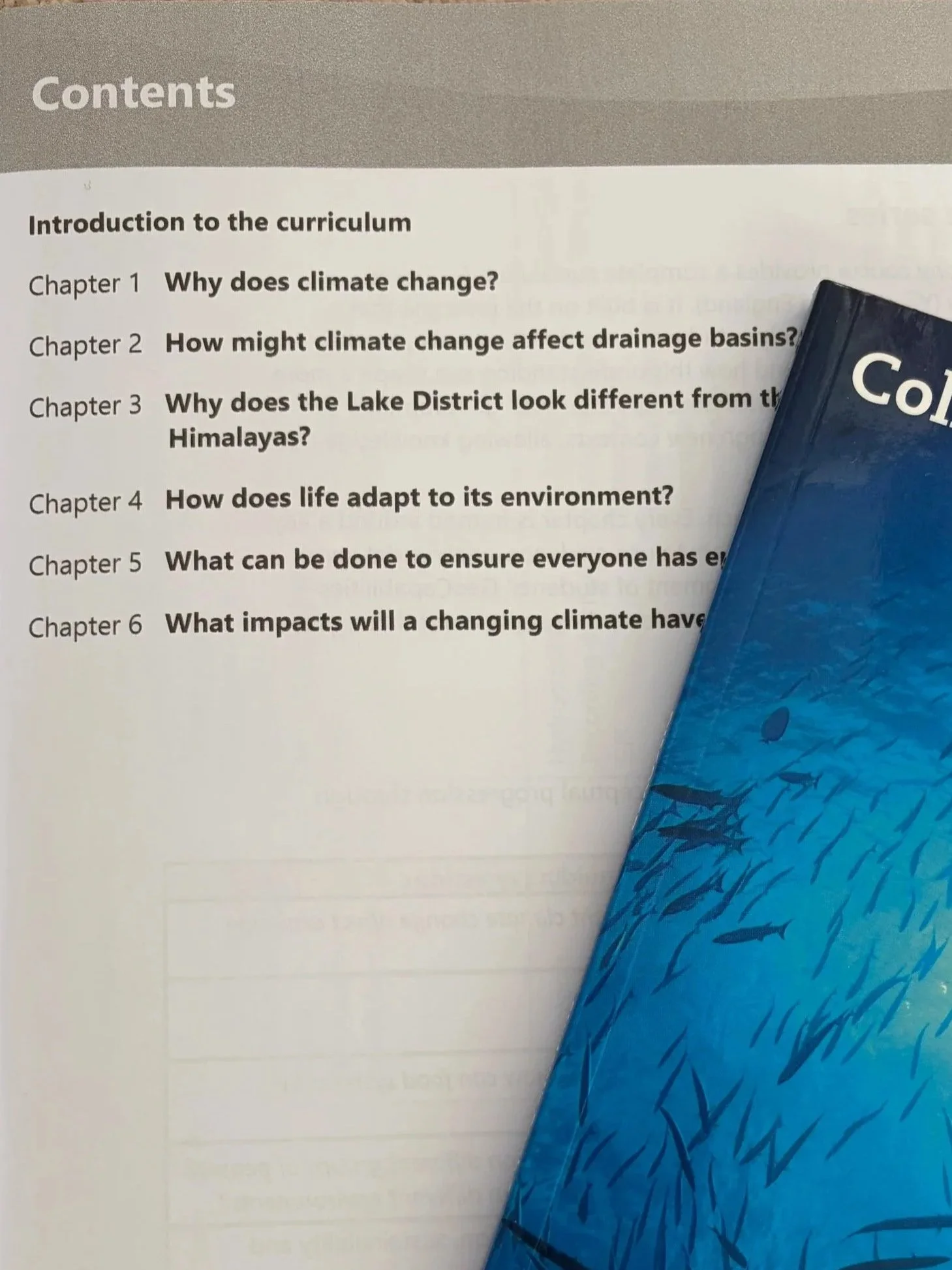
Now, this won’t be for everyone and will spark discussion in far more depth than the scope of this blog will allow but, climate change runs through the very core of this series. Indeed, the first topic of the Year 7 book is climate change. Whilst this is not a choice that I’d personally make (my choice for the first topic of Year 7 is discussed here), it is certainly unique. Students begin by learning ‘Why does climate change?’ in Chapter 1 before this theme is inherent in each and every chapter. For example, Chapter 2 reframes a more traditional rivers topic as ‘How might climate change affect drainage basins? and the book ends with Chapter 6 ‘What impacts will a changing climate have?’
As I say, this approach will spark (important) debate and discussion and not everyone will agree. But, as with all the other ideas shared in this blog, I’d encourage you to have a look at these resources and consider your own position: what are the arguments for and against starting a Key Stage 3 geography curriculum with a unit on climate change? What are the opportunities and strengths of placing it as such a central theme in every topic? What are the threats and possible weaknesses of this approach? How do you teach and embed climate change in your own curriculum and, having considered the approach used in this series, how do you reflect on the decisions you’ve made?
Command words and independent practice
In the workbook, the questions for each textbook spread are categorised as:
1. Connect back / revisit
2. Expand
3. Predict
Whilst the importance of retrieval practice and ‘connecting back’ is familiar to us all, I think that, in some contexts, such a focus on this has come at the expense of other essential components of a geography curriculum. In some cases, for example, the balance has tipped too far towards retrieval with minimal time given to the application of knowledge or for the enquiry thinking that we know is so critical in geography.
It is therefore wonderful to see a workbook with questions so carefully thought out to ensure that geographers develop, practice, and improve all of these skills over time. It was the ‘predict’ questions that particularly gave me food for thought as these are the questions that (arguably) provide the space for deeper geographical thinking and application of knowledge. I pondered the place of ‘predict’ in geography: where does ‘predict’ sit in the hierarchy of geographical command words and related skills? What are we asking students to do when we say predict? What other skills and knowledge must they have to predict properly?
From here, the natural next step was to reflect on our own curriculum: do we have enough opportunities for students to predict and really think hard? Where are the most purposeful points to ask students to predict? Is there progression in this hard thinking and considering of the future (if that’s what we’re agreeing to predict is) over time?
Some of my favourite predict questions from Workbook 7- which interestingly all come from Chapter 3 comparing the Lake District to the Himalayas- definitely a chapter to look at in depth if you purchase these resources!
How do you think human activities might change landscapes in the next 100 years?
Imagine climate change causes temperatures to rise by 2 degrees Celsius in both regions. How might this affect the Lake District and the Himalayas differently?
Imagine new technology makes it easier to live in very cold places. How might this affect human settlements in the Himalayas?
So, there are my thoughts following a deep dive into the Year 7 resources of the Discover Geography package from Collins. Hopefully you’ve found this useful and it’s encouraged you to get your hands on a copy to do the same!
To hear more from the authors of this series, consider watching this webinar.