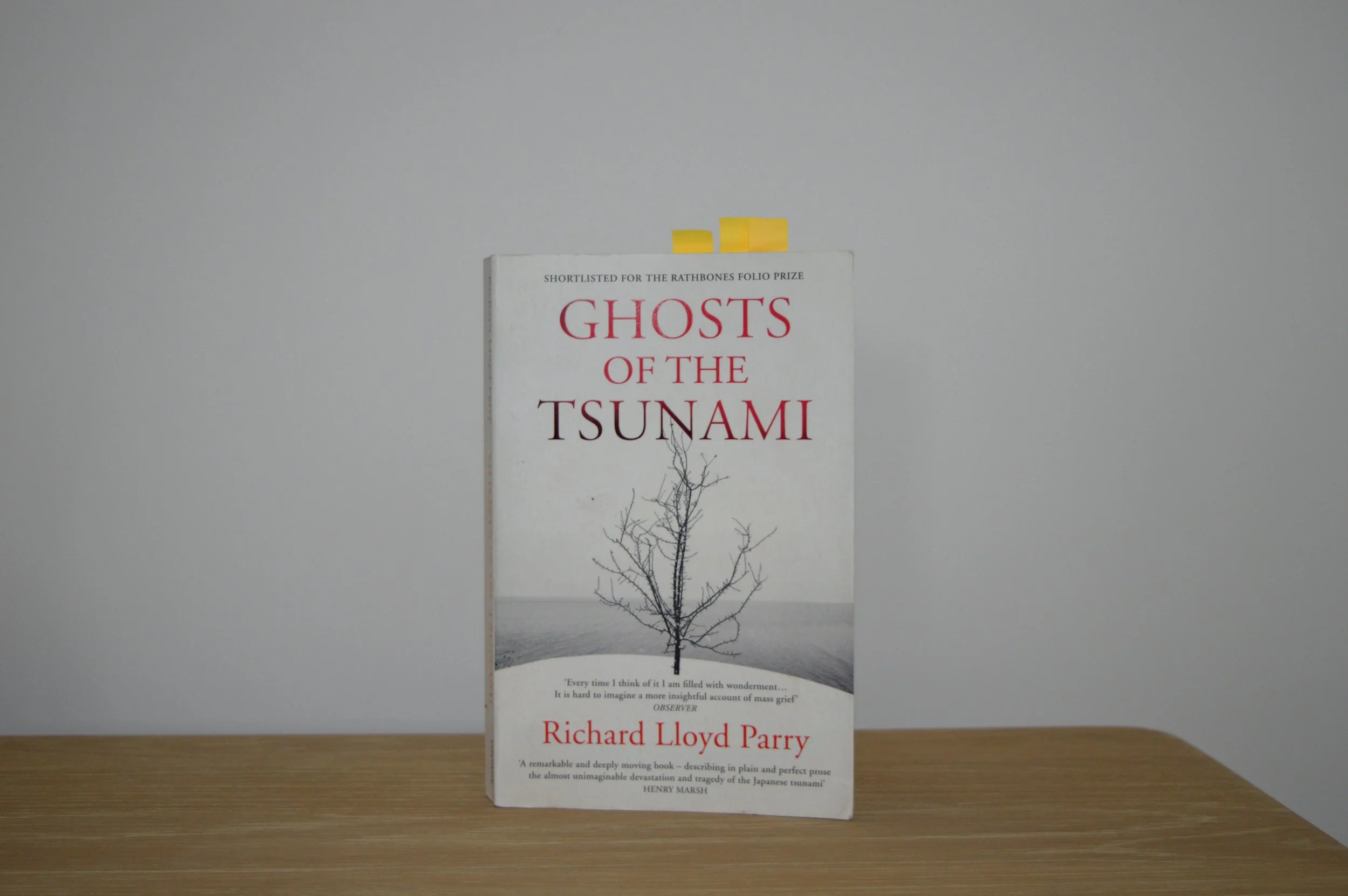
Ghosts of the Tsunami
January 2026
Overall verdict: ★ ★ ★ ★
To buy this book, click here.
Why this book?
This is a long-overdue book review…
When I first read this book many years ago, whilst I thoroughly enjoyed it as a book, I dismissed it for use in the classroom or as part of our curriculum. Recently however, as part of work to reframe how we teach tectonics at KS3, I revisited the book and was shocked that I’d dismissed it all those years ago… it is a gold-mine for a rich, descriptive (yet factual) narrative about what it’s like to experience an earthquake and tsunami and what happened when the tsunami struck Japan in 2011. For anyone wanting to use text extracts in their teaching of tectonics, this is an obvious choice alongside Disaster By Choice.
I have also recently completed a project based on this book for ‘The Ambitious Years’ project of Myatt and Co. Those resources can be downloaded here and I would love any feedback about how they land in the classroom!
For students:
For the vast majority of us living in the UK, an earthquake is not something we will ever experience. However much we read about what it might be like to experience one and the devasting impacts they can have, it can be hard to truly imagine what it’s like. So, although this book is not a cheerful read, it is perhaps the best I’ve read for allowing us to begin to imagine what it was like when the tsunami struck Japan in 2011. Although you won’t further your understanding of the mechanisms of earthquakes and tsunamis from this book (the physical geography), you will certainly deepen your understanding of the vast human impacts of hazards and the cultural dimensions of experiencing, and living with, natural hazards (the human geography).
For teachers:
Throughout the book there are myriad extracts that could be used in the classroom and for different purposes. Perhaps most importantly if teaching in a UK context, many of the extracts help us to make the abstract notion of experiencing an earthquake and tsunami more concrete for students. What is it like when the ground beneath you starts to shake? How do you feel when you know what it happening and yet it is completely outside of your control? What does it feel like to know a tsunami is coming and yet not know how big or powerful the wave will be, until it is upon you?
Some extracts describe the limited impacts of the initial shaking of the ground and implicitly link this to the precautions and measures taken in Japan to ensure hazard-resistant design. Some extracts describe what happened just before the tsunami struck whilst others describe the wave itself and the incredible damage caused as this water engulfed the coast.
The following extracts are perhaps the most useful to consider for use in the classroom:
Prologue
p.2-3 where ‘swarms’ of earthquakes are discussed and the day of the earthquake and tsunami dawns in Japan.
p.4-5 where there is an excellent description of the (limited) impacts of the initial shaking on an office block clearly built to withstand powerful quakes with numerous hazard-resistant design features.
The bottom of p.5 where the limited initial impacts of the earthquake are described (linked to the recommended precautions having been taken) but the severity of the impending tsunami starts to dawn.
Part 1, Chapter 1
p.21 – 22 where the initial shaking of the ground is experienced by a family who try not to panic. As in the extract signposted above in the prologue, this is an extract which makes it clear that there was very little damage from the earthquake itself- most of the infrastructure remains standing.
p.23 - 24 where it describes what Sayomi spotted before the tsunami wave appears: the water in the creek retreating before the channel become momentarily completely dry.
Part 3, Chapter 3
p.134-135 where the wave arrives and the sounds, smell and colour are richly described- allowing you to imagine what it was like in that moment.
For more food for thought about teaching tectonics using text, read this blog about how we reframed our KS3 tectonics unit.
To buy this book, click here.