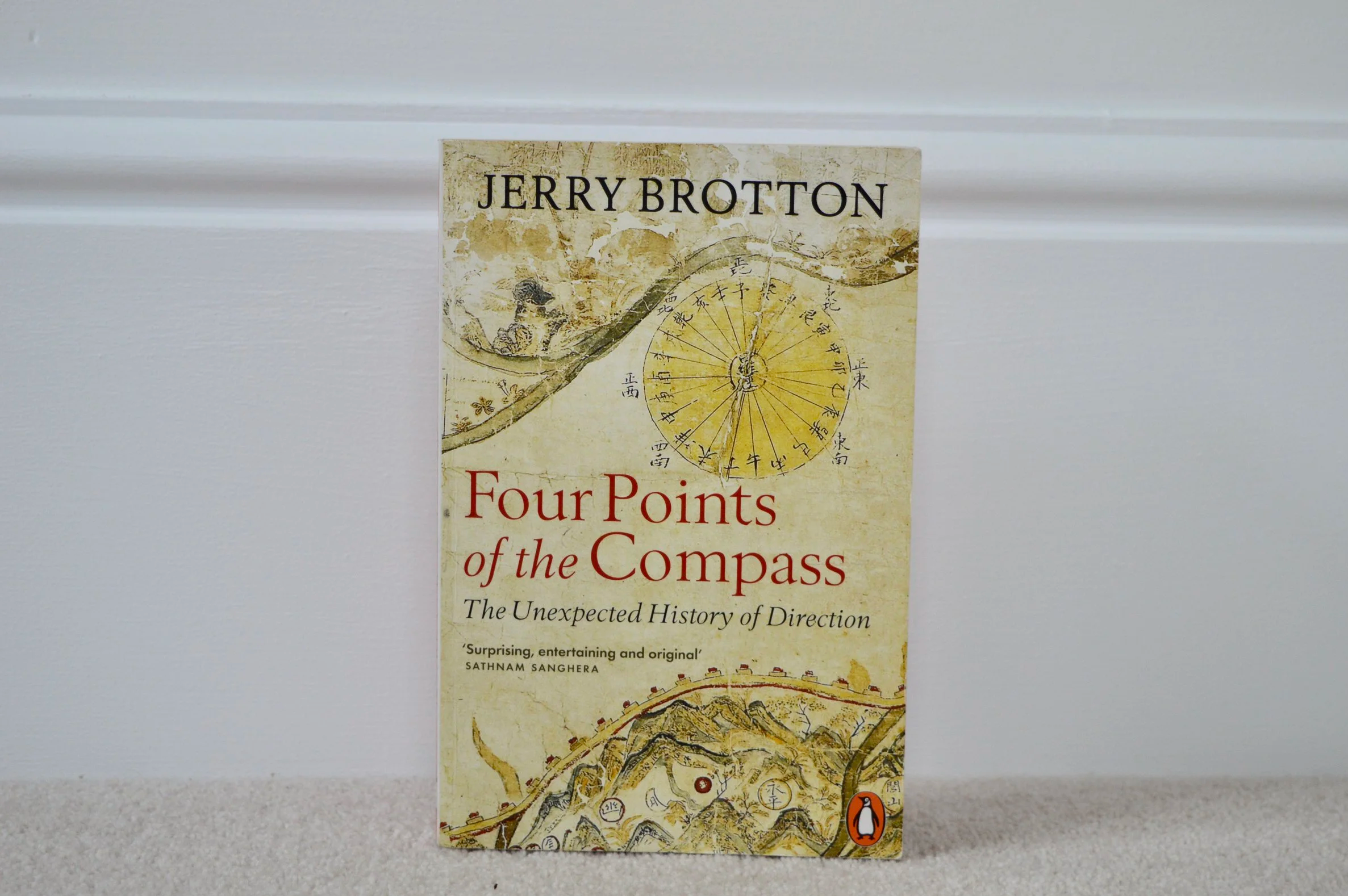
Four Points of the Compass
October 2026
Overall verdict:
To buy this book, click here.
Why this book?
There was a point last year when it felt like everywhere you looked, mapping was being discussed. Be it podcasts, RGS lectures or articles in the papers, it felt like the mapping was having a moment and conversations about how we should teach maps and mapping in 2026 came to the fore. At the same time, I saw lots about this book and was intrigued but resisted the hardback price tag! It was during a visit to Hay Festival 2026 when I spotted the paperback copy on the shelf that I could resist no longer and treated myself to a copy.
Whilst the book is an informative read, there is much that, whilst interesting, went slightly over my head as someone who struggles when things get a little too historical! Despite this, there was still plenty that gave me food for thought and it is the concluding chapter titled ‘The Blue Dot’ that will be of particular interest to any fellow geography teacher. Here, author Jerry Brotton challenged my thinking about what it might mean to be ‘map literate’ in an age of GPS, digital mapping and online identities- as detailed below. I previously blogged about mapping in the 21st century here and lots of the quotes below directly link to these ideas.
For teachers:
Ahead of the concluding chapter, the following quotes (and the text that followed) caused me to pause and got me thinking:
‘These four (referring to the cardinal points) simple and universally accepted terms are far more subjective and specific to time, place, language and culture than we might realise.’ (p.3)
‘Today, what is understood as the East is changing its geo-political meaning more rapidly than any other cardinal direction, wherever you live on the globe.’ (p.59)
‘The East is no longer the site of a European colonial career, nor even simply the emblem of daily renewal and the passage of time, but the location of some of the globe’s most dynamic economies- Singapore, South Korea, Vietnam, Taiwan- and what may soon be the world’s largest economy of all: China. It is the direction of the global future.’ (p.60)
‘The Global South is more of a relation than a location. This is why it includes so many regions usually categorised as ‘eastern’, including the maritime worlds of the Indian and Pacific oceans. But there is no such place as the ‘Middle’ or ‘Far’ South: in contrast to the East, the South is more of a frame of mind than a direction’. (p.85)
‘The north is also one of the most powerful yet contradictory markers of persona identity: depending on where you live on the globe it can signify modernity and prosperity or poverty and backwardness.’ (p.87)
‘The North’s future is now focused not just on its topography, but on the very real possibility that climate change could mean that what is understood as the north might not exist in a few years.’ (p.121)
‘More than any other cardinal direction- including east- west became detached from its origins as a direction and transformed into an ideology.’ (p.143)
As these quotes show, this book is about far more than ‘just’ the history of the 4 points of a compass. It explains how each of the cardinal points is so much more than a point on a map or direction of travel but, instead, how they embody our complex understanding of the world and the resultant geopolitics.
As I said above, it is the concluding chapter titled ‘Blue Dot’ that was of particular interest to me as a geography teacher. This chapter explains how we are all shaped to some degree by the cardinal directions (as our locations and identities only make sense relative to other places and people) before arguing that, in today’s digital age, a grasp of the cardinal directions appears to be waning. By exploring how our relationship with maps has evolved during the 21st century so far, the chapter naturally encourages you to reflect on your teaching of maps and map skills- as I did here.
Something I hadn’t considered before reading this chapter was the argument that ‘for many of us, our most important address is our email, accessible wherever we are, regardless of geographical location. Many other physical locations that used to direct our lives- such as supermarkets, banks, law courts, even places for childhood play- are moving online, enabling us to create online personae and avatars, symbolised by the blue dot moving through cyberspace’ (p.157). What, I wonder, does this mean for our sense of place and the sense of place of those who have never known any different? Is it true that our most important address is our email? At what age does this become true? To what extent do our modern-day digitized mapping tools mean that ‘in exchange for the absolute certainty of knowing where we are in space, we sacrifice our sense of place’ (p.159)?
I’ll end this blog with a few lines that will particularly stick with me, all from p.158:
‘In our digitized century, there are now five directions- north, south, east, west and the online blue dot: ‘You’
‘Eyes glued to that jerky little blue ball, we spend less and less travel time observing the physical terrain through which we move, and more time bumping into others as we go. Speed of movement- in cars, trains and aeroplanes- increasingly replaces distance and direction’
‘What matters most is where we stand and how we consume, often at the expense of an immersive understanding of and interaction with our physical domain.’
To buy this book, click here.