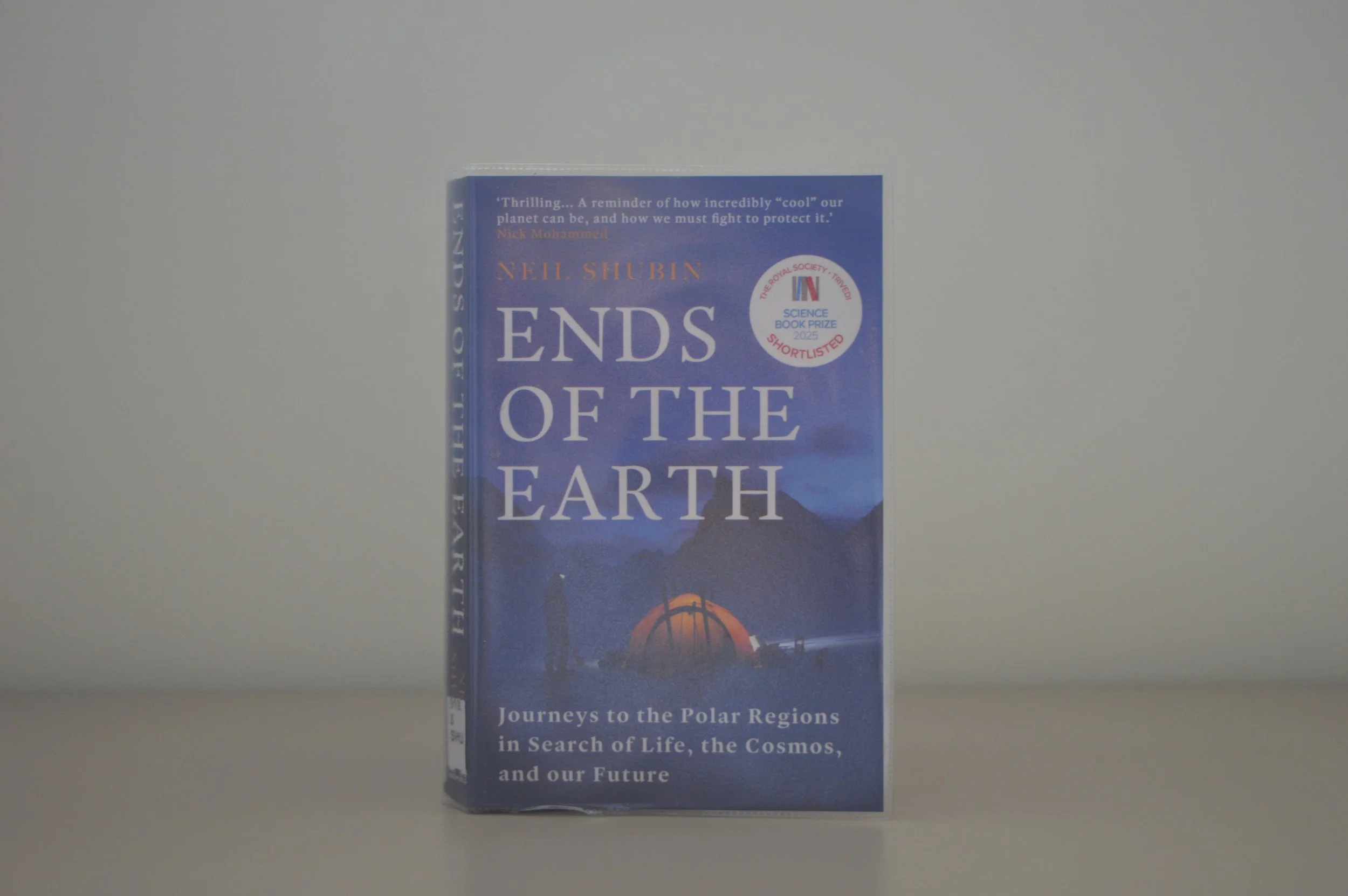
Ends of the Earth
March 2026
Overall verdict: ★ ★ ★
To buy this book, click here.
Why this book?
I picked this book up from the ‘new books’ section of my local library and was excited to read something about the poles- a region I don’t often read about. Antarcticness, Empire Antarctica and Arcticness are excellent reads but those are all a few years old; it’s relatively rare to see books exploring the polar regions in depth as this book does.
So, I got stuck in! The book is relatively dense and goes into a huge amount of detail in places. If you studied glaciation and the polar regions as part of your degree / geography studies, lots of the book will be an interesting refresher of this knowledge. If you haven’t studied this before, you’ll likely learn a lot! It is well written but just a little too dense in places for me- hence the 3 stars overall.
Although there was not too much that I’ll take from the book to use or inform our curriculum directly, that likely says more about our current curriculum focus (e.g. not teaching much about the poles) than the book itself. I did learn lots and, if curriculum reform sees glaciation and the poles having renewed significance in our curriculum, will return to this book.
For teachers:
Having just started teaching Weather and Climate to our Year 8 students, there was one particular extract that I knew I needed to scan in and circulate around our Trust! In our lesson linking latitude to climate, I knew that I wanted us to teach about the significance of the concentration of solar radiation at the equator compared to the poles rather than anything about ‘distance’ from the sun. However, I wasn’t really sure how to articulate this beyond ‘AQA don’t credit it at GCSE’ and, as someone who never wants to do things just because the ‘exam board says so’, this was problematic. I was therefore very grateful to find this expertly explained on p.8 and quickly circulated it as a short subject-knowledge update.
As I said above, there isn’t too much more that I’ve taken directly into our curriculum but, if you do teach more about the polar regions, this book would be excellent for:
Facts and figure about the significance of the polar regions
Rich descriptions of what life in like in these regions
Discussion of glaciers and glaciation at the poles
The environmental impact of melting glaciers
Animal and plant adaptations to survive in the polar climate (examples that go beyond those found in the textbooks)
To buy this book, click here.