What if… we ensure our curriculums are fit for the 2030s?
Written November 2026
When the new National Curriculum is published, we’ll be working on geography curriculums that, hopefully, will take us well into the 2030s. Of course, there will be constant tweaking with each passing year but, on the whole, the framework we construct to meet the requirements of the new curriculum is likely one that will take us well into the next decade. So, what curriculum firsts might we see in coming years? Which pieces of substantive knowledge might we see being taught in geography classrooms for the first time? What might we have skimmed over in the past that now warrants far greater depth of discussion?
I’m looking forward to seeing the answers to these questions arise. Regardless of curriculum reform, it’s been something I’ve been thinking about recently as I near the end of writing the common curriculum for Future Academies. This work begun when we rolled out Year 7 in September 2023 and will ‘end’ (as much as curriculum work ever can!) in July 2027 when the current Year 9 cohort are the first to have finished the Key Stage 3 curriculum. As I explained here, working in a Trust Lead role has afforded me more headspace for complex curriculum thinking than I ever had before and I’m really proud of the curriculum we’re now teaching across the 8 Future Academies schools. So, what has featured as curriculum firsts (for me) in this project? What have I included in this 2023 - Present curriculum that was absent in the previous curriculums I lead from 2015-2018 and 2018 – 2022? In this blog, I look at the ‘what’ and ‘why’ of 3 of my curriculum firsts.
Rewilding
In our second topic of Year 7 (Our Home the UK) where students answer the big question of ‘How and why have human and physical processes shaped the UK?’, we teach about the concept of rewilding.
Having learnt about how humans have shaped the landscape through deforestation, agriculture and settlement (Lesson 9) before explicitly considering how the human and physical landscape are linked (Lesson 10), the study of rewilding felt like a natural next-step (Lesson 11). We look at current actions across much of the UK to return our landscape to a more natural form. With the ever-increasing news coverage of the climate and biodiversity crisis, I wanted to ensure that our students have knowledge of what rewilding is and what is aims to do so that they can engage knowledgably with arguments and debates around the potential of rewilding approaches.
In the lesson, students study an example of a rewilding project to learn about biodiversity and how it can be increased with the reintroduction of species. Through doing so, they also further develop their understanding of the interconnections between the human and physical landscape. In my opinion, this clip is currently the best available to use and students complete this handout.
Climate Stripes
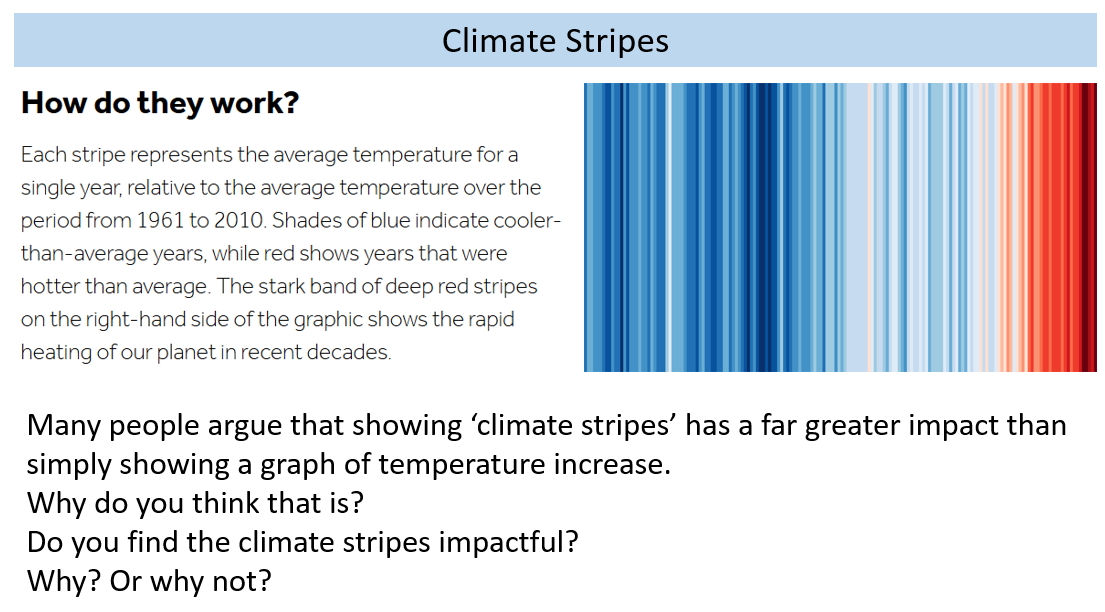
In our final topic of Year 8 (Energy and Climate Change), students answer the big question of ‘Would the world be a better place without fossil fuels?’ Having learnt that the climate of planet earth has always changed, we move onto anthropogenic climate change and how the emissions of greenhouse gases are causing the enhanced greenhouse effect and rapidly increasing global temperatures. Here, the lesson introduces students to the climate stripes from the University of Reading as a unique method of data presentation- something I’d not taught about before.
In the good old days of EduTwitter, I’d regularly share bits and bobs that I’d magpied from Alan Parkinson’s LivingGeography blog to read, listen and watch, and use in the classroom. I still visit his blog regularly and am always provided with food for thought about how to advance my own curriculum work. Alan regularly shares things linked to the climate strips project and it is from there that I realised we really should be teaching this in our geography classrooms today.
Teaching about climate stripes as a data presentation tool is an example of where opportunities to amplify the disciplinary knowledge within your curriculum may be hiding in plain sight- as I blogged about here. When looking at the climate stripes for London since 1850, we consider the following questions to ensure our Year 8s are thinking like a geographer: Why do many people argue that showing climate stripes has a far greater impact than simply showing a graph of temperature increase? Do you find the climate stripes impactful? Why? Or, why not?
Renewable energy through the lens of hope
The 3rd and final example comes from the very end of the same Y8 Energy and Climate Change topic. Of course, I’ve always taught about the advantages and disadvantages of different energy sources and normally reverted to a classic table comparing the 3 fossil fuels to the key renewable energy sources of wind, solar and hydroelectric power. In this ‘new’ curriculum, I wanted to ensure we went further and ensured that students recognised the huge global progress that has been achieved with regards to renewable energy sources in recent years. In the second curriculum I taught (2018-2022), this used to be briefly covered within our Factfulness scheme of work but, having retired that unit, I needed to find a new home this knowledge. I also wanted to ensure we looked at this significant progress in sufficient detail- rather than just briefing introducing it as an idea.
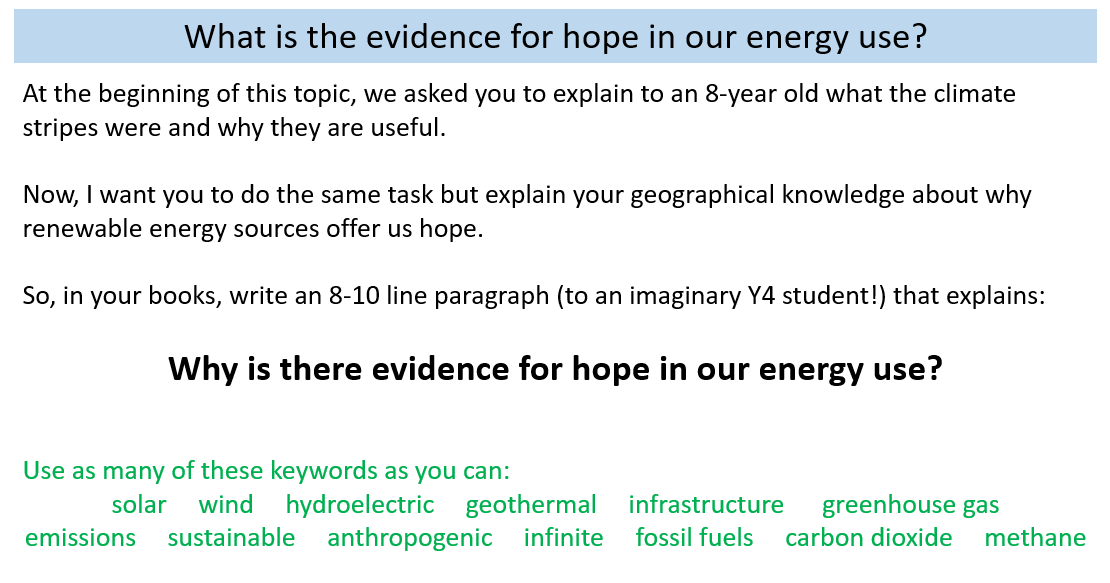
So, after a lesson on how the world is increasing moving to renewables, I end the topic with a lesson about why renewables offer hope- drawing on the work of David Alcock regarding the importance of using hopeful framing, where possible, in our curriculum. The curriculum first was to consider the evidence for hope in our energy use at a national and global scale. This centred around completing this handout which uses 4 different headlines and pieces of data to show the progress being made with regards to the increasing use of renewable energy sources. Each piece of evidence is unpacked in turn, linking back to knowledge gained both in this topic and previously in the curriculum, before the independent practice of the lesson asks students to write an 8-10 line paragraph that explains: ‘Why is there evidence for hope in our energy use?’
So, there we have it, 3 curriculum firsts that I’ve included in this third curriculum of my career and which, when writing since 2023, felt essential to take our curriculum into the 2030s! As I said at the start of this blog, we await the new firsts that will result from curriculum reform and what we’ll find ourselves teaching for the first time from 2028 onwards!