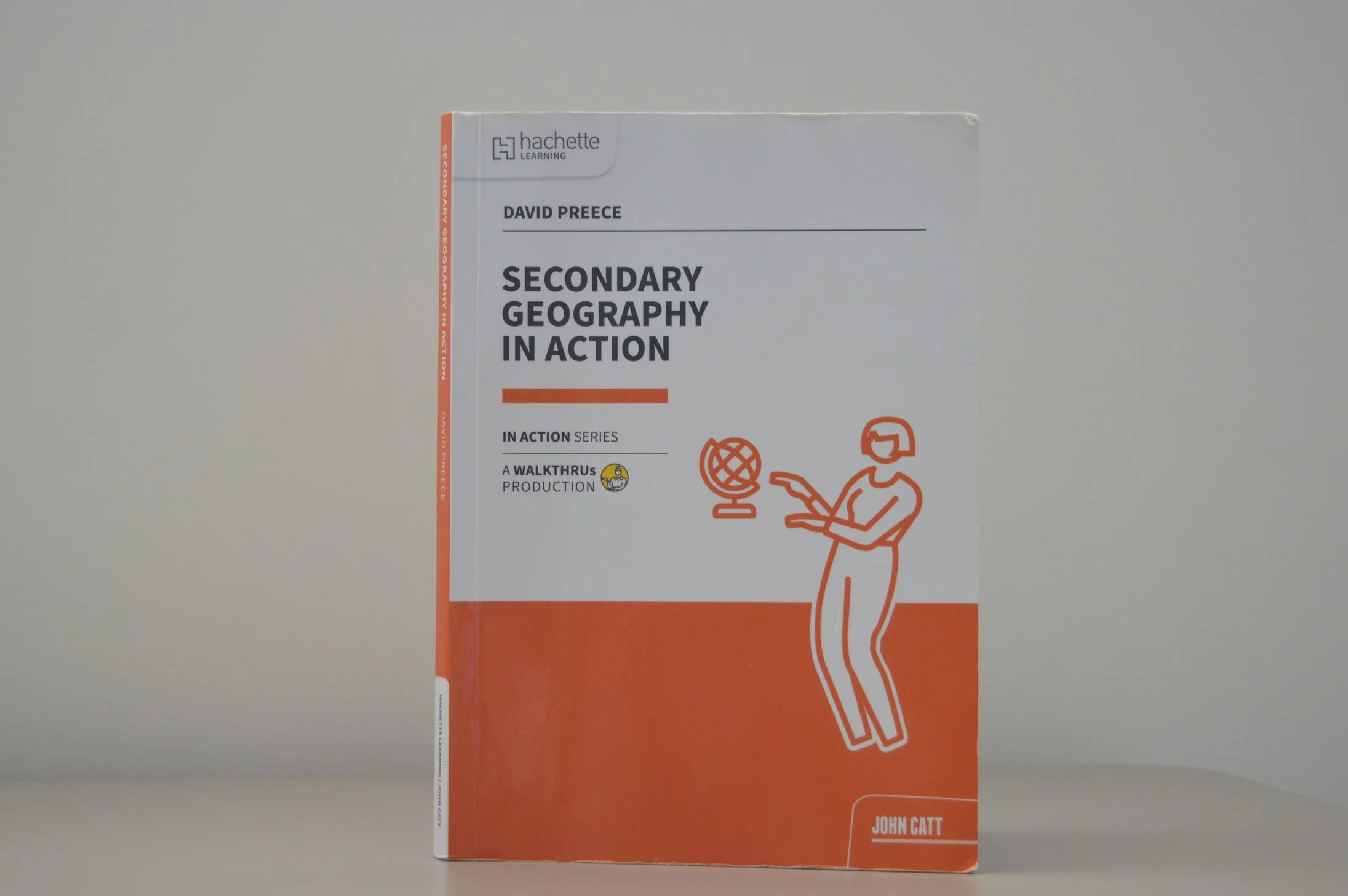
Secondary Geography In Action
April 2026
Overall Verdict: ★ ★ ★ ★
To buy this book, click here.
Why this book?
This academic year I’m determined to get back into reading more about teaching and learning in geography as opposed to constantly picking up the broader subject knowledge books that are my to-go. So, this relatively recent release by David Preece was the next on my to-be-read pile!
This book really does what it says on the tin: it’s a walk-through of what great secondary geography teaching looks like in action- aligned with what research and cognitive science tells us is best practice in the classroom. For that reason, it is an excellent read for classroom teachers of geography who want to apply the approaches, issues, debates and strategies that they have likely learnt about in generic whole-school training to our subject of geography. What does it mean to ‘start with the end’ in geography? What does effective modelling and scaffolding look like in geography? How can we create a culture of geographical scholarship inside and beyond our classrooms?
In my opinion, for a classroom teacher wanting to improve their practice, this book is a perfect complement to Making Every Geography Lesson Count by Mark Enser. Whilst the writing styles and structure of these books are very different, the messages of how to teach high-quality geography are consistent and, with each author choosing to go into more depth on different components, both complement each other really nicely.
For more experienced colleagues, it’s worth nothing that owing to the breadth of the book, this is not (and importantly it doesn’t claim to be!) a book that will develop a deeper level of knowledge and thinking around curriculum intent, structure and coherence. It will however introduce the key ideas needed to begin this thinking by giving an overview of how to approach the discipline of geography (Chapter 2) and introducing you to ideas of how to sequence your curriculum (Chapter 4) and how to assess progress in the curriculum (Chapter 10).
What I particularly like are the ‘critical reflection’ boxes that pepper the book where necessary. These boxes mean that, at regular intervals, David forces us to remember that not every geography lesson, classroom and department are the same and we must think carefully about how ideas, skills and strategies play out in the reality of our context. To me, these boxes that pause me to think and reflect (critically!) are a powerful tool in helping ensure that the book feels grounded in the reality of ‘normal’ classrooms.
Three key takeaways:
1. Whilst discussing conceptual frameworks as an approach to geography: ‘It’s arguably interconnection (or synopticity) that gives geography the strongest disciplinary identity. Maude (2016) argues that interconnection is the ‘basis for geography’s claim to be an integrative discipline- and it’s common for us to explain the ‘geographical lens’ and the relationship between ideas as the key feature that makes geography distinctive.’ (p.19)
2. Whilst discussing whose geographies do we teach (Chapter 5): ‘It’s important to work hard to avoid falling in to ‘deficit model’ thinking where we constantly present our cultural perspective as ‘the norm’ and anything different from that as a deficit that we need to ‘fix’.’ (p.56)
3. There are many challenges facing the geography teaching community now and in the near future. This chapter in the book gave me lots of food for thought and I used it with our SCITT trainees to do the following:
Summarise each challenge in 2-3 sentences of your own words. What is the challenge and how does it affect us as geography teachers?
At this point in your training year, which of these 8 challenges resonates with you the most and why? How has it affected / impacted your teaching?
To buy this book, click here.