Aiming for A*
Upcoming CPD
I’m looking forward to delivering two webinars for Cooper Education in early 2027.
In January, I’ll be sharing how I teach EQ3&4 of the Regenerating Places topic of the Edexcel A-Level geography specification.
In February, I’ll be sharing how I teach EQ3&4 of the Migration, Identity and Sovereignty topic of the Edexcel A-Level geography specification.
Written June 2026
How to stretch and challenge the most able A-Level geographers to get an A* grade is a question that I get asked a lot. It’s tempting to assume that the answer is simply ‘more’- more reading, more case studies and more content beyond the specification. Whilst I don’t disagree with exposing the most able to the broader context of their studies, I do think that teachers can be tempted to focus on the wrong things and thus risk overwhelm rather than impact.
Put simply, there is already plenty of content in the 2-year Edexcel A-Level geography course for even the most able students to learn. So, I think we have to be very careful when suggesting that more, more, more is the answer to a top grade. Rather, I think we need to think carefully about how we guide students to ensure they can access the top marks.
Now, of course, going beyond the specification is part of aiming for, and achieving an A*. In my blog series titled ‘Going Beyond the Specification’, I’ve shared my top resources for doing this and exposing (all) students to the broader context of what they’re studying and seeing how their A-Level content fits into the wider world. However, I’d argue that there is a limit as to how ‘off-piste’ from the specification we need to go.
Instead, I like to stretch and challenge the most able A-Level students by doing the following:
1. Ensuring they are super secure in the knowledge of the specification itself.
This includes the niche bits that can (sometimes understandably) be skipped over or not focused on as often in terms of retrieval practice and knowledge consolidation. It means ensuring that students are able to use all of the specific terminology stated in the specification with confidence so that they can use it in their own writing to demonstrate their knowledge and understanding.
Below is the table of keywords and phrases that I would want an A* student to be secure in for the globalisation and superpowers topic.
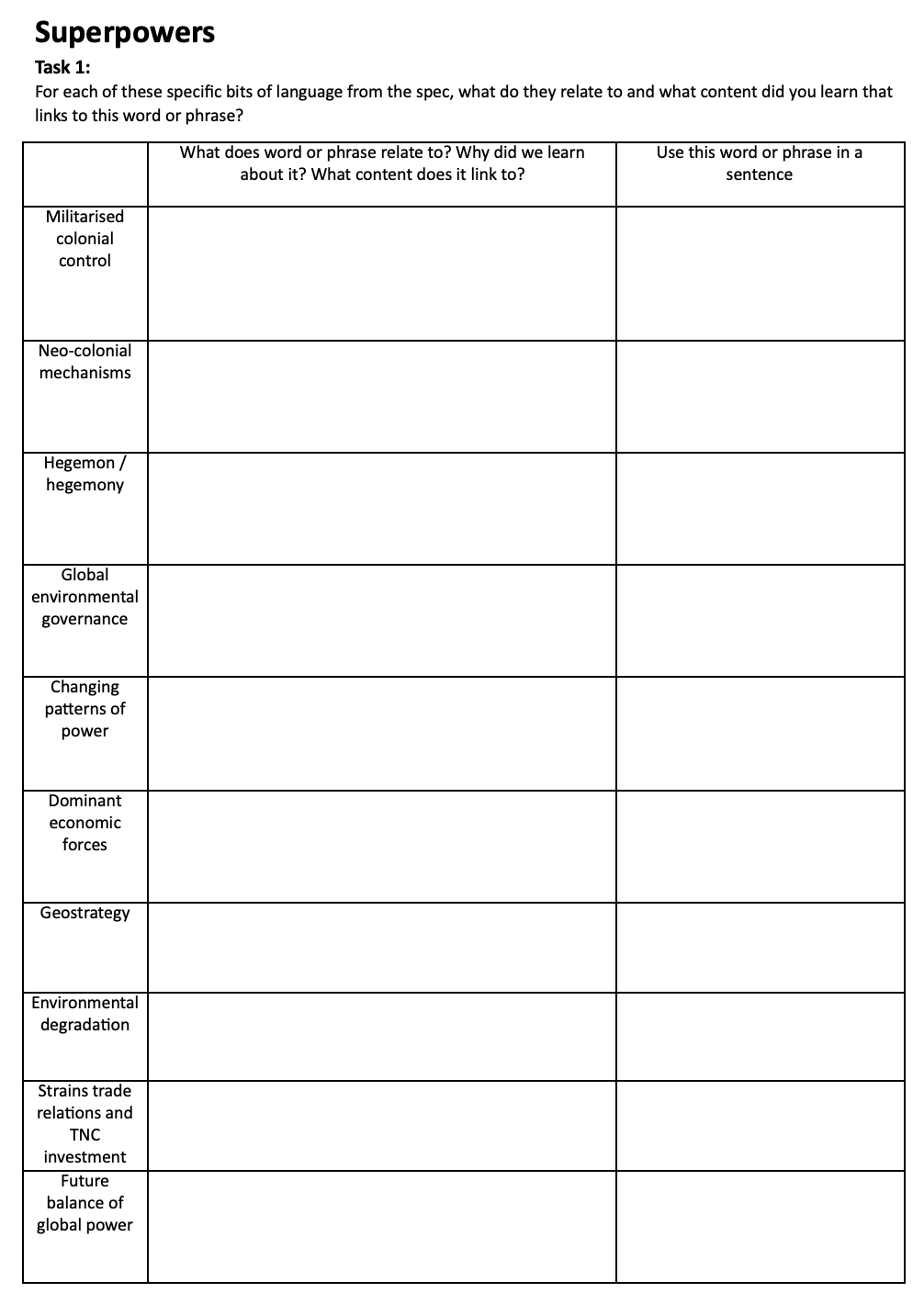
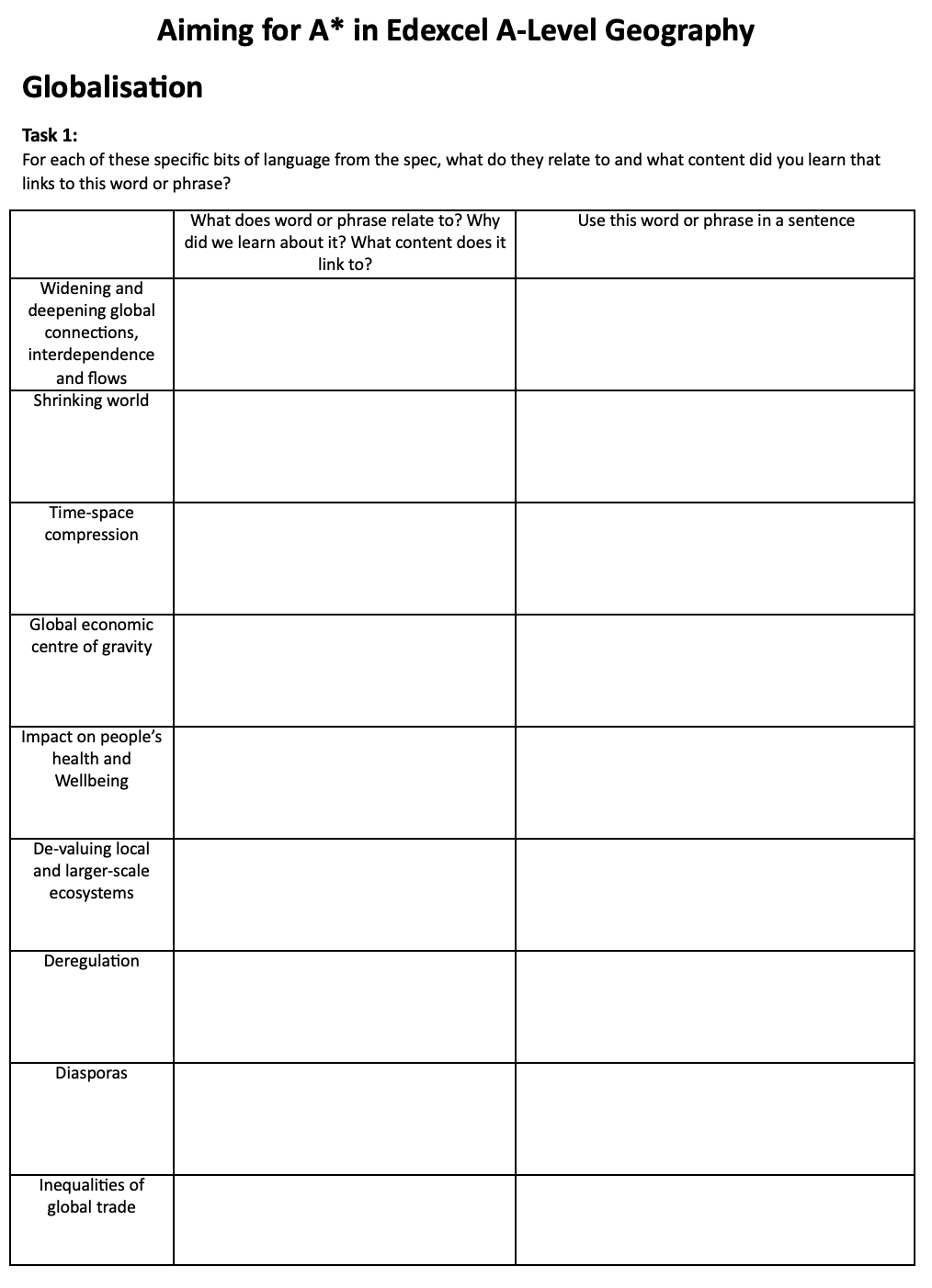
2. Ensuring they have completed all of the carefully considered extra reading that has been signposted to them throughout the course.
So, for those aiming for an A*, rather than saying ‘read more’, I ask them to have engaged properly with everything that I’ve shared in my teaching. Many of these articles, clips and podcasts are shared in the ‘Best Bits’ blogs for the globalisation topic and superpowers topic.
3. Developing their ability to think synoptically using geographical concepts
We know that synoptic thinking is essential for success in Paper 3 of the Edexcel geography course but it can be hard to nurture within students. We also know that a set of key concepts underpin the A-Level course and so, in my experience, combining these two is the best route to success. Much of our work on concepts comes at the end of Year 13 as we prepare for Paper 3 but, in my opinion, the resources in the pack below work well for students to begin thinking about how the concepts of climate change, sustainability, and risk offer a lens through which to think synoptically and draw together their studies.
Resources in the ‘Aiming for A*’ pack
The first task is quite specific and uses a podcast to draw together the ideas of endangered languages (Globalisation 3.6b), increasing tensions in the Arctic (Superpowers 7.7) and vanishing landscapes through climate change (studied throughout).
The second task uses the excellent TED Talk by Hannah Ritchie to get students to critically consider the concept of sustainability. The TED Talk asks students to think about whether any generation before us has truly been sustainable or whether we might be the first.
The third and final task included uses the excellent Global Risk Reports of 2025 and 2026 to introduce students to the concept of risk that underpins much of their studies. As I say, we will do much of our work on the key concepts at the end of Paper 3, but the tasks in this pack sow the seed for thinking about where the concept of ‘risk’ underpins each topic.
So, this pack is what I’d share with those aiming for an A* and ask them to work through independently to complete. As you’ll see, they need to have finished the Superpowers topic in order to complete some of the tasks and so they would be given this around Christmas of Year 13. However, I suppose you could split up the tasks and give some to students in their Year 12 summer?
Ultimately, as I hope is obvious here, my advice for students aiming for an A* is not to chase endless amounts of additional content but rather to focus on mastering what they have been taught and developing their ability to think synoptically across the course. I hope it’s useful and helps you answer that question of how to achieve an A* in geography!